
The origins of yoga go back thousands of years, and the practice of yoga for health has become popular worldwide. A 2016 survey estimated that 36 million Americans may be involved in yoga to varying degrees, for example. With so many practitioners, what do we really know about yoga?
What Are the Benefits of Yoga?
As I discuss in my video How to Prove Whether Yoga Has Special Benefits, researchers have found that yoga users have better health status and are less likely to be obese, but that could be reverse causation––meaning instead of yoga leading to better health and a normal weight, maybe being in better health, not being obese, is leading to more yoga. Same with the flipside. When you read that yoga practitioners are more likely to have mental health conditions, such as depression or anxiety, and musculoskeletal conditions, like arthritis, gout, lupus, fibromyalgia, joint pain, sprains, and asthma, yoga may be contributing to some of these conditions, like muscle sprains, but for most of them, it’s probably reverse causation—people with diseases seeking help. Are they getting it? The only way to know for sure, is to put it to the test, which we’ll explore, next.
Yoga for Mental Health
Sadly, for depression, yoga doesn’t even seem to have a benefit, compared to doing nothing. Yoga does appear to be helpful with anxiety, but not for people anxious to the extent that they’re actually diagnosed with an anxiety disorder. And, all the benefit from yoga on anxiety appears to be from the physical activity, since there appears to be no benefit compared to other types of exercise. So, unfortunately, yoga does not appear to be effective for mood and anxiety disorders.
That held up even among older adults, too. Psychologically, yoga appeared to beat out other exercises for alleviating depression in older adults, but not anxiety or perceived mental health in general.
What Does Yoga Do for Our Body?
There are some conditions for which yoga really does appear to pull ahead, though. For example, chronic nonspecific neck pain, which I cover in my video Yoga Put to the Test for MS, Back Pain, Neck Pain, Insomnia, and Breast Cancer. Based on 10 randomized controlled trials, not only was yoga better for neck pain than control groups in general––which included doing nothing, yoga also seemed to beat out active controls, other types of exercises. The authors tentatively conclude that yoga can relieve neck pain intensity, improve pain-related disability, increase range of motion, improve quality of life, and boost mood among neck pain sufferers.
What about the benefits of yoga practice compared to physical exercise in the management of type 2 diabetes? As I discuss in my video Yoga Put to the Test for Headaches, Diabetes, Osteoarthritis, and Older Adults, a significant reduction in both short-term and longer-term blood sugar control was noted in the yoga groups compared to other exercise control groups. However, the findings may need to be interpreted with caution, since nearly half of the studies didn’t define and adhere to a well-planned exercise regimen in the control group. Furthermore, an exercise intervention comparable in intensity to yoga was followed only in three out of the eight studies included. And, for what it’s worth, the majority of the studies, six out of eight, were from India.
Yoga was examined as a therapy for irritable bowel syndrome, too, and evidence from randomized controlled trials found that yoga beat out drugs and was equally effective as moderate intensity walking.
Yoga for Strength
What about compared to other exercises? Yoga pulled ahead for lower limb strength and lower body flexibility, but for improving balance, mobility, and walking speed, yoga appeared comparable.
What happened when researchers studied yoga and bone strength? They devised a 12-minute DVD of 12 yoga poses that they believed would stimulate increased bone density in the spine and both parts of the hip. It appeared yoga did provide benefit in the spine, but not the hip. In the end, though, out of the 741 patients recruited at the start of the study, only a few dozen actually sent in their bone scans as instructed. So, that’s only about 5% of the study participants. You can imagine how those who got positive results were more likely to send them in, while those who failed just kind of slunk away. So, I don’t consider this convincing evidence.
Yoga for Women
Several conditions disproportionately affect women, like insomnia. Does yoga help? Yoga works compared to nothing, but not for physically active controls. And, for cancer patients—mostly breast cancer patients—walking was found to be more effective than yoga at improving sleep. For markers of systemic inflammation in breast cancer survivors, six months of yoga had the similar effect as six months of non-yoga exercise. Same with cancer-related fatigue, and quality of life for women with breast cancer: better than nothing, but no better than other types of physical activity. Finally, for breast cancer survivors, the effectiveness of yoga interventions in breast cancer-related lymphedema, an abnormal accumulation of fluid for which there is no effective treatment, and adding yoga does not seem to help.
Yoga and urinary incontinence have been investigated, too, which I look at in my video Yoga Put to the Test for Depression, Anxiety, and Urinary Incontinence. There are two different types of urinary incontinence: urgency incontinence, defined as an involuntary loss of urine associated with a sudden strong desire to urinate, or stress incontinence, where an activity such as sneezing triggers an involuntary leak. Three months of yoga didn’t seem to significantly help overall incontinence, but it did seem to help with stress incontinence, decreasing by an average of 61% in the yoga group versus only 35% in controls with no significant changes in urgency incontinence.
See my video Yoga Put to the Test for IBS, Inflammatory Bowel, Menopause, and Osteoporosis for more information.
The Adverse Effects of Yoga
In my video The Side Effects of Yoga I discuss a systematic review included nine observational studies with more than 9,000 yoga practitioners and 9,000 non-yoga practitioners from the United States, Europe, Asia, and Australia. A considerable proportion of yoga practitioners experienced injuries or other adverse events. However, most were mild and transient, and risks were comparable to those of non-yoga practitioners. The risk of yoga-associated injuries was estimated as 1.45 per thousand hours of yoga practice––much lower than in higher-impact sports activities, such as soccer. Compared to 1.5 for yoga, runners have about 2.5 injuries per thousand hours; soccer 3.7; 5 for tennis, and an hour of yoga is more than five times safer than skiing.
The bottom line is that like any other type of physical activity, yoga carries a risk of injury. Exercise is indeed medicine, but like any medicine, it must be prescribed appropriately. Many patients rely on their yoga practice for stress reduction. So, it is important to be mindful that being injured is the last thing you need. The higher-risk yoga poses appear to include headstand, shoulder stand, lotus and half-lotus, forward bend, backward bend, and handstand, so beginners should be beware, with particular attention paid to the spine, as this is where the highest number of injuries occur.
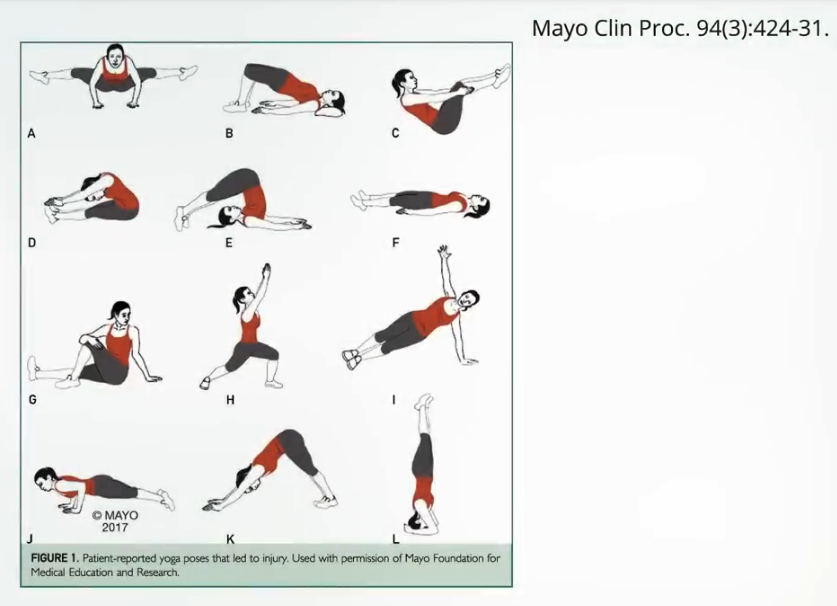
As with any other physical or mental practice, yoga should be practiced carefully under the guidance of a qualified instructor. Beginners should avoid extreme practices such as headstand, lotus position, and forceful breathing. Individuals with medical preconditions should work with their physician and yoga teacher to appropriately adapt postures. For example, patients with glaucoma should avoid upside-down positions, and patients with compromised bones should avoid forceful yoga practices, and practices like voluntary vomiting should perhaps be avoided completely.